There is more to do in Egypt than just ride a camel

My final paper for Soc 211 was about Egyptian archaeology and I spoke about the pyramids, Sphinx, I also provided information about archaeology work that is ongoing in Egypt and a little information about the Egyptian Museum. When most people think about Egypt, they think about a pyramid in the middle of the barren desert, like the picture below. In some instances they might right because there are pyramids in the middle of the barren desert, just like the picture below.
I think that is one of the things that makes all all of the archaeology work and finds so interesting. Typically, people settle and build cities and structures near water. The Nile river runs through Egypt and you would think that if someone was going to build a massive pyramid, they would do it much closer to the river and a water source but they didn't do that. I say that just to get you to think about all of the building, by hand and without any machines, that went on over 4000 years ago.
This is my travel blog for your trip to Egypt. That way you can go see the amazing pyramids with your own eyes. Then, after you finish seeing all of the amazing archaeological wonders and you are hot and dirty and dusty you can hop into the Red Sea and cool off.

Egypt is a huge country. It is close to being square as it is 997 miles from north to south and 743 miles from east to west and most of the country is actually barren desert. It should be said that Egypt is in Africa and not, as most people think, in the Middle East. Egypt is bordered on the east by the Sinai peninsula and south of the Sinai is the Red Sea, the northern border of Egypt is the ocean, to the west is Libya and bordered on the south by the Sudan.
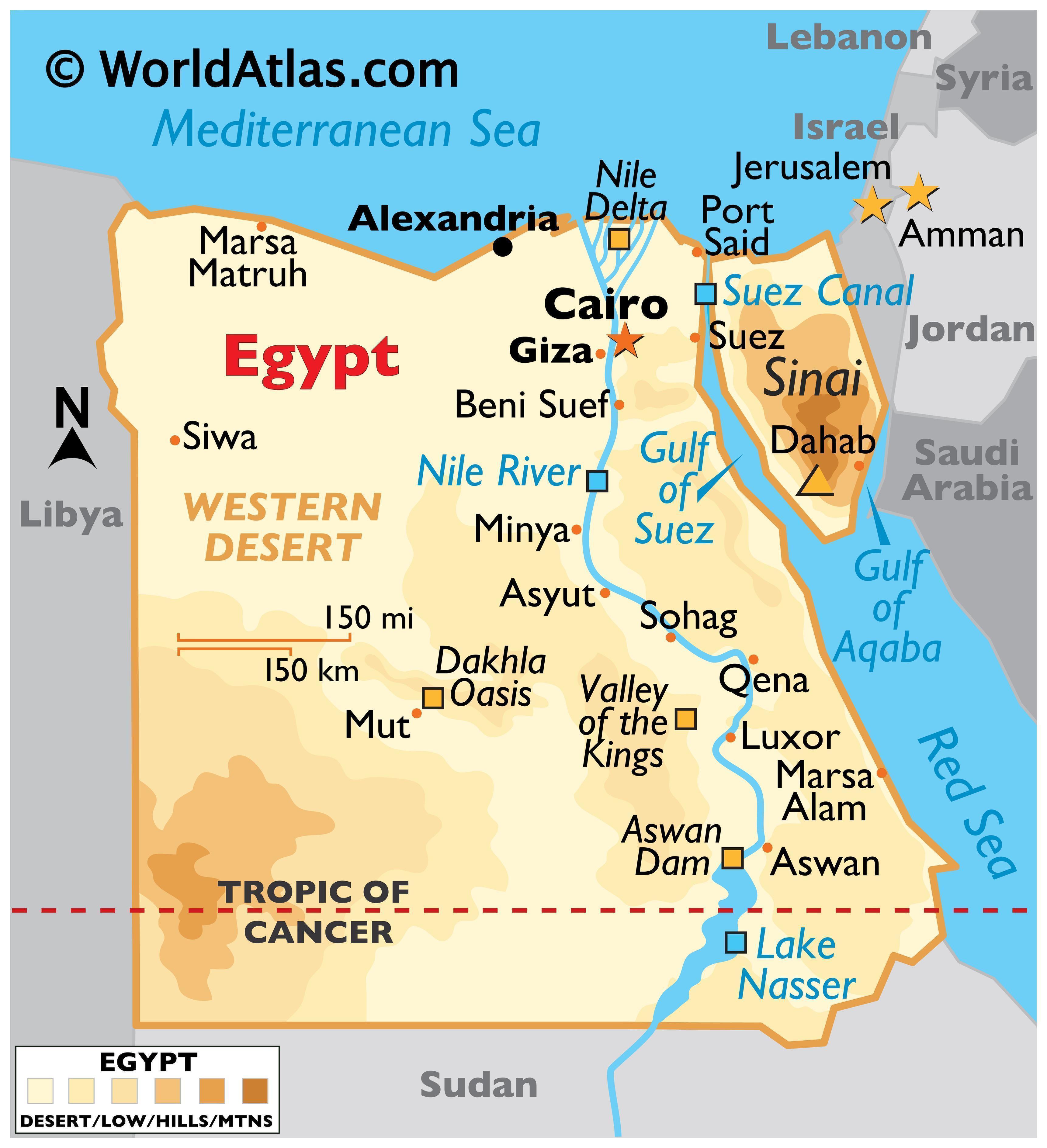
Most people think about Egypt as primarily Cairo, which is the capital, but Alexandria is a huge seaport city on the northern end of the country. It lies on the mediterranean sea. In ancient times it was the capital of Egypt, before the capital was moved to Cairo. The city was founded by Alexander the Great. There are some interesting sights and architecture to see in Alexandria and it sits at the mouth of the Nile River, which flows from Africa all the way north through the entire country of Egypt. They have a beautiful waterfront and you can take a river cruise from Alexandria down the nile river to see many of the sites and cities in Egypt.
Travel south from Alexandria and you arrive in Cairo. Cairo is the big bustling overcrowded city and does have the sights that everyone has heard of like the great pyramid of Giza, the Sphinx just outside the city and the Egyptian museum located right downtown in Tahrir Square. It is the capital of the and the most densely populated city in the country. Traffic can be bumper to bumper all day and you can sometimes walk to your destination faster than you could drive there. Most of the sights to see are not directly in Cairo itself, but outside the city.
Moving south from Cairo, the place to visit is Luxor and the Valley of the Kings and Valley of the Queens. This area is so rich in history that new tombs and temples are being unearthed all the time. Luxor became known as the home to Amun, the God of sun and air. The area is called the Valley of the Kings because from approximately 1550 - 1050 all of the kings chose to be buried there to be close to Amun and queens who were buried there were buried in the Valley of the Queens. In addition to building tombs, the Pharaohs built ornate mortuary temples that were connected to the tombs.

The relationship between Egyptian royalty and the God Amun was extremely strong. “Amun was often credited by the queens of Egypt as having fathered their children. When Queen Hatshepsut came to power, she inscribed the story of her divine birth, from the union of Amun and her mother Queen Ahmose, on the wall of her mortuary temple at Deir al-Bahri" (Jarus). The most well known of all the mortuary temples, was built by Queen Hatsheput and it included three colonnaded entrances which lead into a sanctuary and it has scenes showing them making voyages to a far off land.

I have talked about some of the archaeological sites to see in Egypt and where they can be found. Now I want to switch gears and talk about having some fun in the sun. If you look at the small map above you see that Egypt is bordered on the east by the Sinai peninsula and the Red Sea. At the bottom of the Sinai lies Sharm El Sheikh. Sharm is a mecca for great scuba diving and having fun in the sun and on the water. However, the Red Sea does have sharks that may occasionally get curious about what you are doing and decide to come take a look for themselves. If that happens, then maybe you can make a new friend and exchange email addresses.

Sharm has great resorts that are all along the ocean and cater to water sports. You can go scuba diving, snorkeling, ride wave runners or just lay in the sun on the beach. Even the snorkeling right off the beach was amazing. As you can see from the picture above there is a reef right off the beach. The water is crystal clear and warm. The other great place they have in Sharm is Cleopark. It is a water park that has great rides and attractions. The slides are great and Sharm is a fun place to spend sometime relaxing on the beach after the hustle and bustle of touring archaeological sites.

However, if you want a little more adventure in your day and sand in your hair and eyes you can book a trip on camelback to a Bedouin village where you can see how the Bedouin's live, the crafts they make and the dishes they cook. The trip is typically for dinner and they make a huge buffet of great food. After dinner there is a show with whirling dervishes and then they take you back to town in a bus so you don't have to ride camels in the dark.

Right now Covid has disrupted the entire world and there isn't much travel for vacations, especially outside of the United States. However, once Covid is dead and buried you should think about taking a trip to see some other people, places and things that were dead and buried but have been carefully unearthed. Go see Egypt and it's archaeological wonders.
References:
Jarus, O. (2013, June 25). Luxor: Ancient Egyptian Capital. Retrieved July 10, 2020, from https://www.livescience.com/37740-luxor.html
Hi David, I very much enjoyed what you’ve written for us on Egypt, especially sites to visit aside from Cairo and Alexandria. I certainly hope to visit it someday. Egypt is steeped in a vast amount of history from the age of the Pharos, the Ptolemaic Kingdom, Roman and Byzantine Empires, the Fatimid Caliphate, as well as the Ayyubid and Mamluk Sultanates. In addition to the Ancient Egyptians discussed, is there another period of their history you find particularly interesting?
ReplyDeleteHello David, I agree that it would make sense to build the pyramid closer to water, but it just goes to show how advanced the Egyptians were with their architecture skills.
ReplyDelete